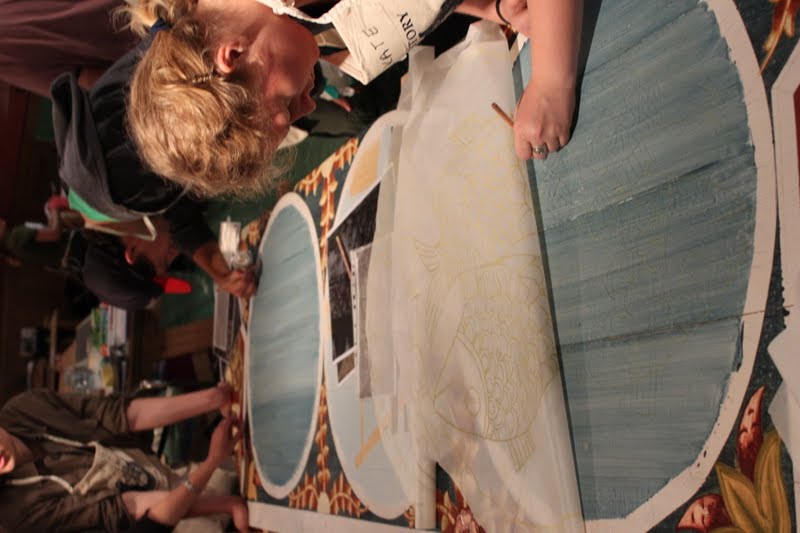
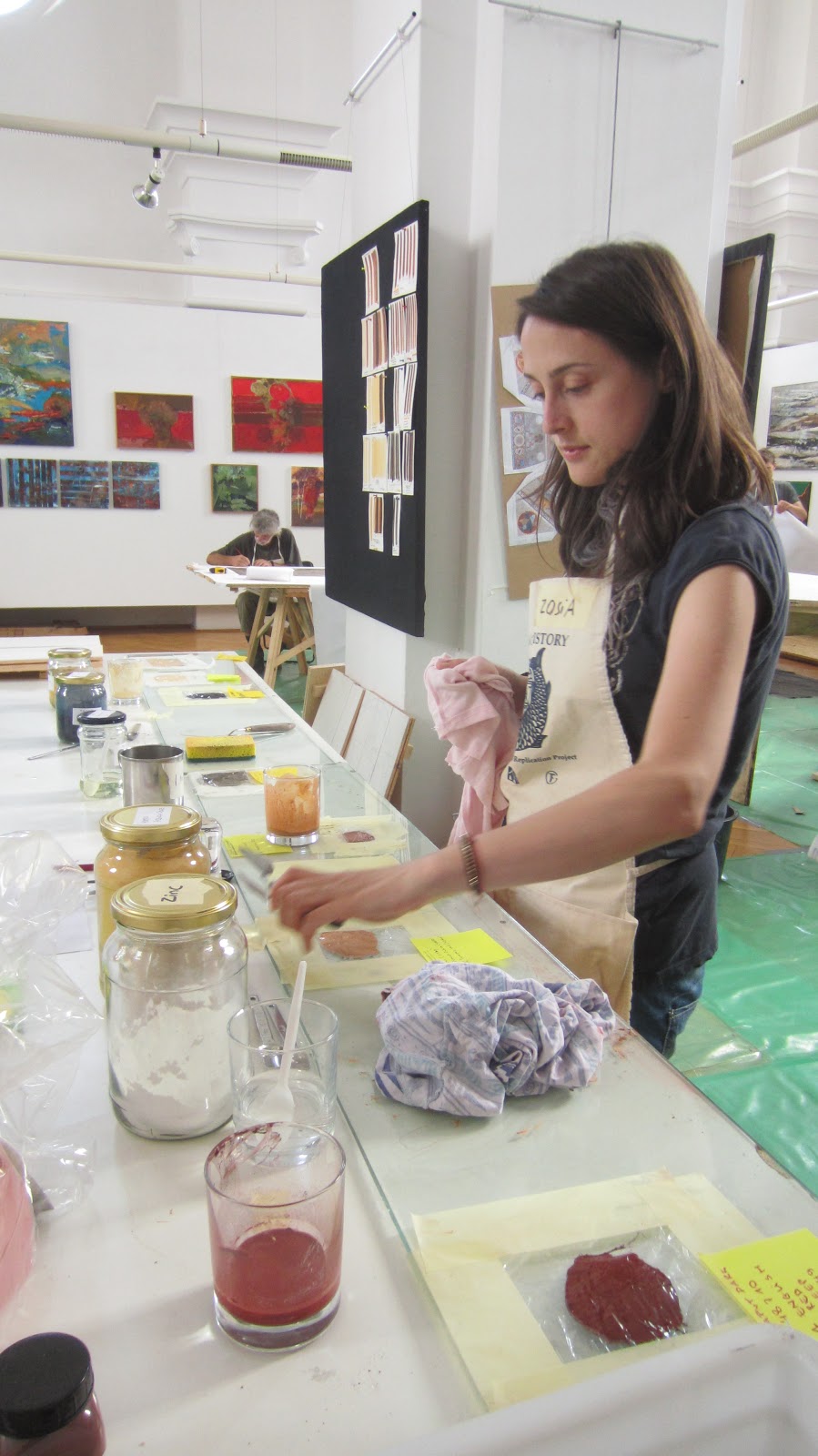
Though the Team and panels have moved on to Krakow and the next workshop is in full swing, this post will be about our wonderful experience in Rzeszow, and a thank you to all those who helped make it a success. Thank you to all of the wonderful students and volunteers who participated in the workshop--who sized half of the ceilings worth of boards on one of the hottest days, helped with all of the necessary prep that goes into getting the first brush stroke of actual paint on the boards, as well as organized activities to discover the history in the community we were working in, and helped us by translating to find lost trucks and such. Thank you also to all the local businesses, including our host the BWA Gallery and the Kryjowka Restaurant, who worked with us on all our strange requests and accommodations. And also, thank you to the entire community of Rzeszow for the hospitality received, and providing us with a truly unique experience with concerts in the square every weekend, daily farmers markets, delicious lody (ice cream) places with at least one on each street off the square, and relaxed atmosphere. So this post is being written to thank all those super stars who contributed to the workshop being a success.
Group 5
 |
| Back Row from Left to Right: Julia Nowak, Rick Brown, Marta Topolewska, Ola Karkonska, Zofia Mioduszewska, Krista Lima, Rashin Fahandejsaadi, Case Randall, Alison Kruvant, Jason Loik, Emily White, Marian Zub, Nick Farnham, Ariel Rosenblum, Kasia Kulinska, Laura Brown. Front Row from Left to Right: Magdalena Czuma, Dan D'Amore, Cailigh MacDonald, Anna Rykier, Jason Bashaw, Marie Brown |
|
 |
| These were the members of Group 5 here for the duration of the Rzeszow workshop. Back from L to R: Julia Nowak, Anna Rykier, Marta Topolewska, Magdalena Czuma Front from L to R: Pola, Alison Kruvant |
Local Heroes
 |
| The BWA Gallery, home of the Group 5 Workshop. The space that is now a gallery was formerly a Synagogue. Before WWII it was the Synagogue for the New Town. The Synagogue for the Old Town actually stands right next it and serves today's purposes as an archive. |
 |
| This is the main gallery space at the BWA that we took over for two and a half weeks. At first glance the space does not seem like the worship hall of a Synagogue as was its original purpose. The remaining features that reference that original purpose are the four large columns in the center of the space, which is where the bimah, a raised structure in the middle of the Synagogue that faces the East Wall and is where the Torah is read, would have stood. |
 |
| The group with the women at the Kryjowka Restaurant who helped keep us well fed with delicious food for two of our three daily meals. |
Special Thanks: Ali Kruvant
 Ali was the only Handshouse student for Group 5. She also participated in two workshop sessions, the first being Group 3/4 which was the final timber framing workshop, and Group 5, the first of three painting workshops for this summer. She also participated in a Handshouse workshop at Oberlin College, where she originally became involved with the project. Ali was a pleasure to work with, a hard worker, loads of fun, and the team was sad to see her go. Here is her reflection of her experience with the project:
Here I am, back in the US of A, wishing I were still in Poland painting the lost ceiling panels of the Gwozdziec Synagogue. It’s a pretty obscure activity to engage in, when you think about it. I had a lot of trouble describing the project to others in less than five sentences. There were so many important details, like the fact it’s going in a museum, that we were traveling to different cities in Poland for each workshop, that the synagogue was burnt down by the Nazis—oh, and it was actually located in present-day Ukraine, which was once part of a Polish-Lithuanian Commonwealth…
Since I’ve been home, I’ve had trouble restraining myself from talking at people for too long, describing my experience in too much glorious detail. But people seem to feed off my passion, much like I did when I first met the Browns back in January 2009. I stayed in Oberlin for two extra weeks, despite freezing temperatures and endless snowfall to join the workshop and help paint two panels from the Gwozdziec ceiling. It was worth it, because I had a great experience and knew I would stay involved with Handshouse projects.
Much like Handshouse Studio’s philosophy of ‘learning by doing,’ my study of art complements my study of art history, and vice versa. For me, they are inseparable. Turns out, I was in the right company: Handshouse projects provide the opportunity to learn about history through art, by investigating the creative process. I am thrilled that I took part in both the art and architectural aspects of the Gwozdziec Synagogue replica. I now have a deeper understanding of the complexity of the project and invaluable knowledge of both timber frame construction and painting techniques.
It’s a shame no one else does. Yes, everyone else who participated in the project, but the greater public, no. I can’t get away from the political and cultural significance of these efforts, particularly because I’m an Ashkenazi Jew and this is much of the reason I decided to participate. I had never seen a 17th century wooden synagogue and was unaware of the sophistication and beauty of these structures. This project introduced me to an exciting example of Jewish cultural heritage that has remained underappreciated for centuries, one that I may otherwise never have encountered.
People came from around the world with a variety of backgrounds, skills, and interests, in order to contribute to the Gwozdziec Rekonstrukcja undertaking. Everyone ate, drank, worked, and played (soccer) together, creating a special kind of community. Disparate (joints) individuals held together by a common (peg) purpose. The work required constant awareness of the body and its surroundings and often involved a group effort. Much of the beauty of the experience came from these human-to-human interactions, our unique commonality and indescribable bond.
Our community might be fleeting but the fruits of our labor have permanence. The beautiful historic object will live in the Museum of the History of Polish Jews, an impressive new building in a neighborhood that used to be an ugly, oppressive Jewish ghetto. Lots of people will see it, love it, learn about it, and tell their friends. Thus we’ll help to preserve knowledge and appreciation of an entire artistic and architectural tradition nearly lost to the Nazis in the Second World War. This is an opportunity to tell a new and [vastly] improved story of Jewish life in Poland. To tell the truth, really.